Case Study: How Flappy Bird Mastered Simple Mechanics
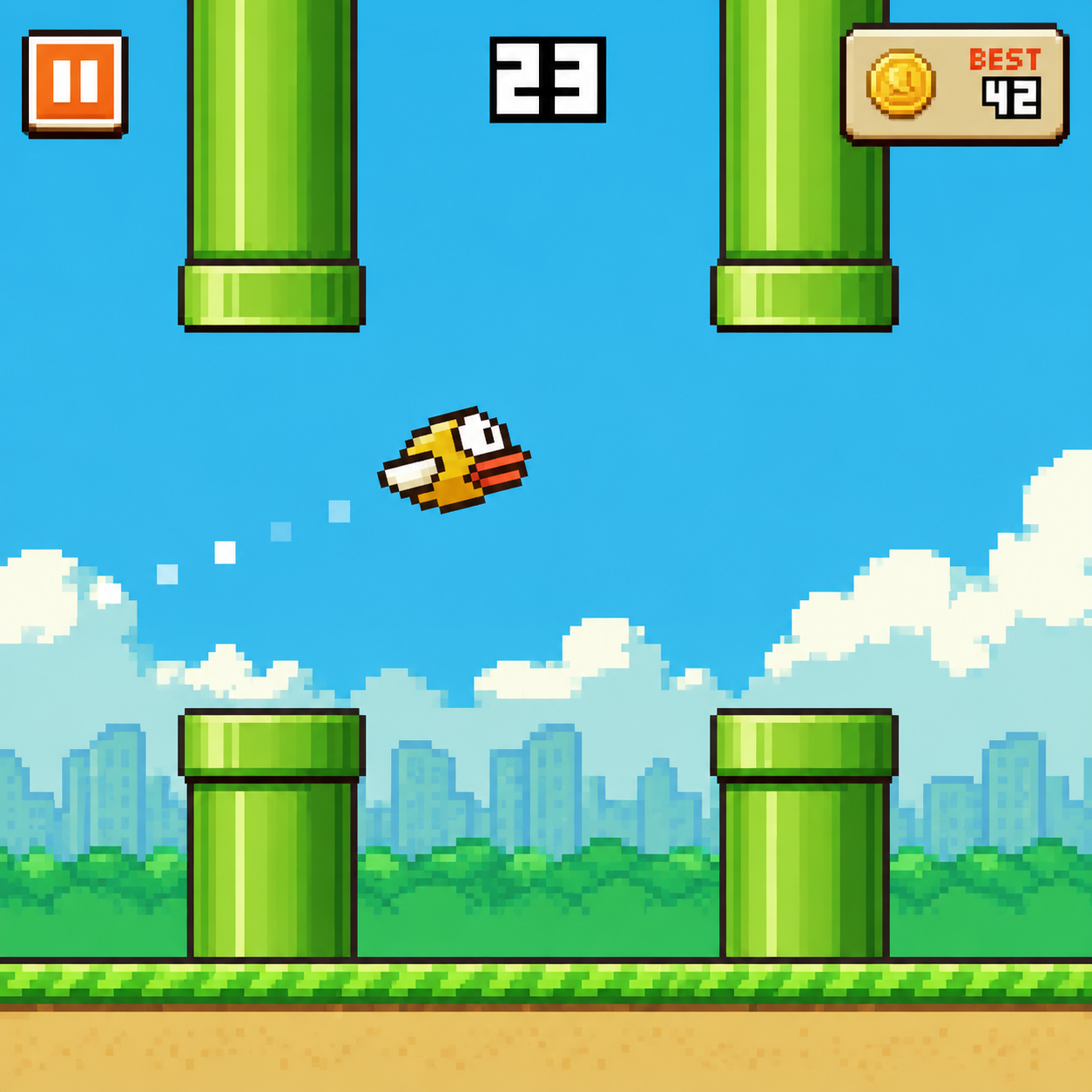
Flappy Bird is a useful game-design case study because its rules are easy to explain but difficult to execute. The player taps the screen to make a bird flap, guides it through gaps between pipes, and tries to achieve a higher score before crashing. That small rule set creates a demanding experience built around timing, attention, and repeated learning.
The game demonstrates an important distinction: mechanical simplicity does not guarantee an easy experience. When gravity, momentum, obstacle avoidance, feedback, and scoring interact precisely, a single input can create substantial depth.
The Core Concept: One Input, One Clear Action
The core mechanic of Flappy Bird is a one-button control: each tap triggers one flap and changes the bird’s vertical movement. Because the relationship between input and action is immediate, players understand the objective within seconds.
The tap-to-flap mechanic gives the player one clear responsibility. Tapping does not steer the bird in several directions or activate a menu of abilities. It produces a brief upward impulse. Between taps, gravity pulls the bird downward, so the player constantly adjusts the timing of the next action.
This creates strong player agency despite the limited control scheme. The player cannot directly choose an altitude with a slider or hold a button to hover. Instead, they shape the bird’s trajectory through a sequence of small decisions: tap now, wait a moment, tap again, or accept that recovery is no longer possible.
The design also removes unnecessary interpretation. The bird’s movement communicates the result of every input, and the obstacle layout makes the next goal visible. A first-time player can observe the game, understand the action, and attempt it without reading instructions. That is a valuable principle for mobile game design: when the input is simple, the consequence should be equally readable.
Turning Movement Into a Challenge
Flappy Bird becomes challenging because gravity, momentum, fixed obstacles, and narrow gaps turn one simple action into a continuous timing test. The control is easy to perform, but the player must perform it at exactly the right moment.
After a flap, the bird rises before beginning to fall again. This movement creates a rhythm rather than a direct command. A tap is therefore both an action and a prediction. The player estimates where the bird will be when it reaches the next pipe, then starts correcting the trajectory before the danger arrives.
The pipes give the game a clear spatial problem. Each gap is a target, but the bird approaches it while moving vertically and horizontally. The player must maintain altitude, avoid the upper and lower boundaries, and prepare for the following obstacle. A successful passage depends on controlling the bird several moments before the collision point.
This is where obstacle avoidance gains depth. The pipes do not need elaborate behavior or random attacks. Their fixed presence is enough because the player’s movement remains difficult to regulate. The challenge comes from the interaction between a predictable environment and imperfect control.
There is also a subtle risk-and-reward decision. A player who taps too aggressively may rise into the upper pipe; a player who waits too long may fall into the lower one. Safe-looking movement can become dangerous when it leaves too little time to recover. The game asks for restraint as often as action.
The Power of a Tight Gameplay Loop
The game’s tight gameplay loop follows a simple sequence: start, flap through pipes, collide, see the result, and retry immediately. Short attempts and fast restarts reduce downtime, making each failure an invitation to test a new timing strategy.
This retry cycle is central to the experience. A failed run usually lasts only a short time, so the cost of another attempt feels manageable. The player does not need to replay a long level, wait through a complex loading sequence, or rebuild a character before trying again.
The loop also preserves concentration. Players spend most of the session in the meaningful part of the game: reading the bird’s position, anticipating the next gap, and deciding when to tap. Menus and progression systems remain secondary because the action itself supplies the reason to continue.
Instant restarts create a useful emotional pattern. A collision produces disappointment, but the next attempt appears before that feeling becomes frustration caused by waiting. The player can immediately test a hypothesis: perhaps the last tap came too early, or perhaps the bird entered the gap too low.
Designers can apply this structure beyond arcade games. A strong loop often has four qualities:
- Low setup time: the player reaches the main action quickly.
- Clear failure: the game shows what ended the attempt.
- Fast recovery: restarting requires little effort.
- Visible progress: a score or distance shows whether the new attempt improved.
Difficulty, Timing, and Player Learning
Flappy Bird feels difficult because its consistent rules demand precise timing, while every failure provides information about the player’s current skill. The difficulty curve emerges from repetition, not from a large collection of increasingly complex mechanics.
Players gradually learn the rhythm of ascent and descent. At first, they may tap whenever the bird appears too low. With practice, they begin to anticipate movement instead of reacting late. They recognize how many taps are usually needed to approach a gap and how much correction remains after a poor entry.
This learning process combines timing, pattern recognition, and adaptation. Even when obstacles appear similar, the player’s position changes from run to run. A gap that was easy at one altitude may become dangerous at another. The environment supplies familiar problems, but the player must solve each one through current trajectory rather than memory alone.
Consistent rules make failure feel informative. If the bird crashes after a late flap, the player can connect the result to a visible mistake. That connection supports a productive skill progression: observe, form a theory, retry, and refine.
There is a trade-off here. A severe difficulty curve can create compelling mastery, but it can also exclude players who prefer exploration or forgiving progression. Flappy Bird is designed around precision and score chasing, so its appeal depends heavily on whether the player enjoys repeated correction. The same difficulty that motivates one audience may discourage another.

Feedback and Minimalist Presentation
Minimalist game design supports Flappy Bird by keeping movement, collision, sound, and scoring easy to read. The uncluttered presentation ensures that the player’s attention stays on the bird’s trajectory and the approaching pipes.
Visual motion acts as continuous feedback. The bird’s animation makes each flap legible, while its vertical position reveals whether the player is rising, falling, or holding a workable line. The side-scrolling environment reinforces forward progress without requiring a map or objective tracker.
Collision feedback is equally important. When the bird hits a pipe or the ground, the run ends clearly. There is little ambiguity about what happened. The score then converts the attempt into a measurable result, giving players a simple way to compare performance with their previous best.
Sound adds another layer of feedback. A flap, point, or collision can confirm an event without forcing the player to inspect a text label. In a game that requires constant visual attention, brief audio signals help communicate state changes while the eyes remain on the playfield.
The presentation is effective because it protects the information hierarchy:
- The bird is the controlled object.
- The pipes are the immediate threat.
- The gap is the next target.
- The score is the long-term measure of performance.
Choosing minimal presentation for clarity means accepting less room for narrative, customization, or visual variety. In this case, that limitation strengthens memorability because the player can recall the entire challenge almost instantly: flap, pass the gap, repeat.
Why Simplicity Created Strong Engagement
Simple mechanics create strong engagement when they offer immediate accessibility alongside a demanding path to mastery. Flappy Bird lets almost anyone begin, but only practice improves consistency.
The game’s accessibility comes from its small vocabulary. Players need to understand one action, one hazard, and one objective. There are no inventories, ability trees, or complicated controls competing for attention. This makes the first interaction approachable, especially on a touchscreen.
Depth appears through interaction rather than feature count. The tap is simple, but its value changes according to altitude, speed, obstacle position, and timing. A single mechanic can therefore produce many situations without requiring a large rules manual.
Score chasing adds a long-term goal. Passing one pipe may feel satisfying at first; later, the player seeks a personal record or tries to reach a score that previously seemed out of reach. Incremental improvement turns small gains into meaningful rewards.
The tension comes from risk accumulation. Each successful gap increases the value of continuing, but it also raises the emotional cost of a mistake. Players may become more cautious after a strong run, which can itself disrupt their rhythm. That psychological pressure gives the final seconds of an attempt more weight than the opening seconds.
Game-Design Lessons From Flappy Bird
The main lesson from Flappy Bird is to reduce systems until every remaining mechanic has a clear job. Designers can build depth through readable actions, meaningful failure, rapid retries, and carefully tuned interaction rather than feature count.
1. Make the primary action obvious
A player should quickly understand what input does and how that input changes the game state. The one-button control works because the tap-to-flap response is visible, immediate, and consistent.
2. Let the environment create complexity
Designers do not always need more abilities or enemy types. Gravity, timing, positioning, and obstacle avoidance can produce a rich skill test when they interact well.
3. Make failure meaningful
A collision should communicate useful information. Players should be able to identify whether they mistimed an action, misread a gap, or failed to recover from an earlier error.
4. Protect the retry cycle
Fast restarts work best when the previous attempt remains fresh in the player’s mind. Remove unnecessary waiting, preserve clear scoring, and return the player to the main challenge quickly.
5. Tune feedback before adding features
Before expanding a project, test whether animation, sound, collision response, and score feedback explain the game clearly. A new system cannot compensate for an action that feels vague or inconsistent.
For a practical review framework, evaluate a prototype through four questions: Can players understand it? Can they predict its consequences? Can they learn from failure? Can they try again without friction? If the answer to all four is yes, a small mechanic may carry more design weight than expected.
Frequently Asked Questions About Flappy Bird’s Mechanics
These answers summarize how the game’s controls, difficulty, retry loop, and minimalist design work together.
What is the core mechanic of Flappy Bird?
The core mechanic is a tap-to-flap control. Each tap gives the bird an upward impulse, while gravity pulls it down, requiring the player to time actions between pipes.
Why is Flappy Bird difficult despite its simple controls?
It is difficult because the player must manage momentum and vertical position with discrete taps. Small timing errors can place the bird too high or too low when it reaches a narrow gap.
How does the game’s retry loop encourage repeated play?
Short attempts, immediate failure feedback, visible scoring, and rapid restarts let players test a new strategy almost instantly. Each run feels like another opportunity to improve.
What can modern game designers learn from Flappy Bird?
Designers can learn to make the main action readable, keep feedback immediate, connect failure to learnable causes, and remove friction from retrying. Depth can come from interaction rather than numerous features.
Why can minimalist mechanics create depth?
Minimalist mechanics create depth when one action has different consequences across changing situations. Timing, risk, spatial relationships, and player decisions can make a small ruleset demanding to master.
Flappy Bird remains a compact lesson in game mechanics because every part of its design points toward the same experience. The one-button control establishes clarity, the obstacle layout creates pressure, the difficulty curve supports learning, and the retry cycle turns failure into another attempt. Its lasting design value lies in that alignment: a few rules, consistently communicated, can produce a surprisingly deep test of skill.