Analyzing the RNG in Popular Gacha Games
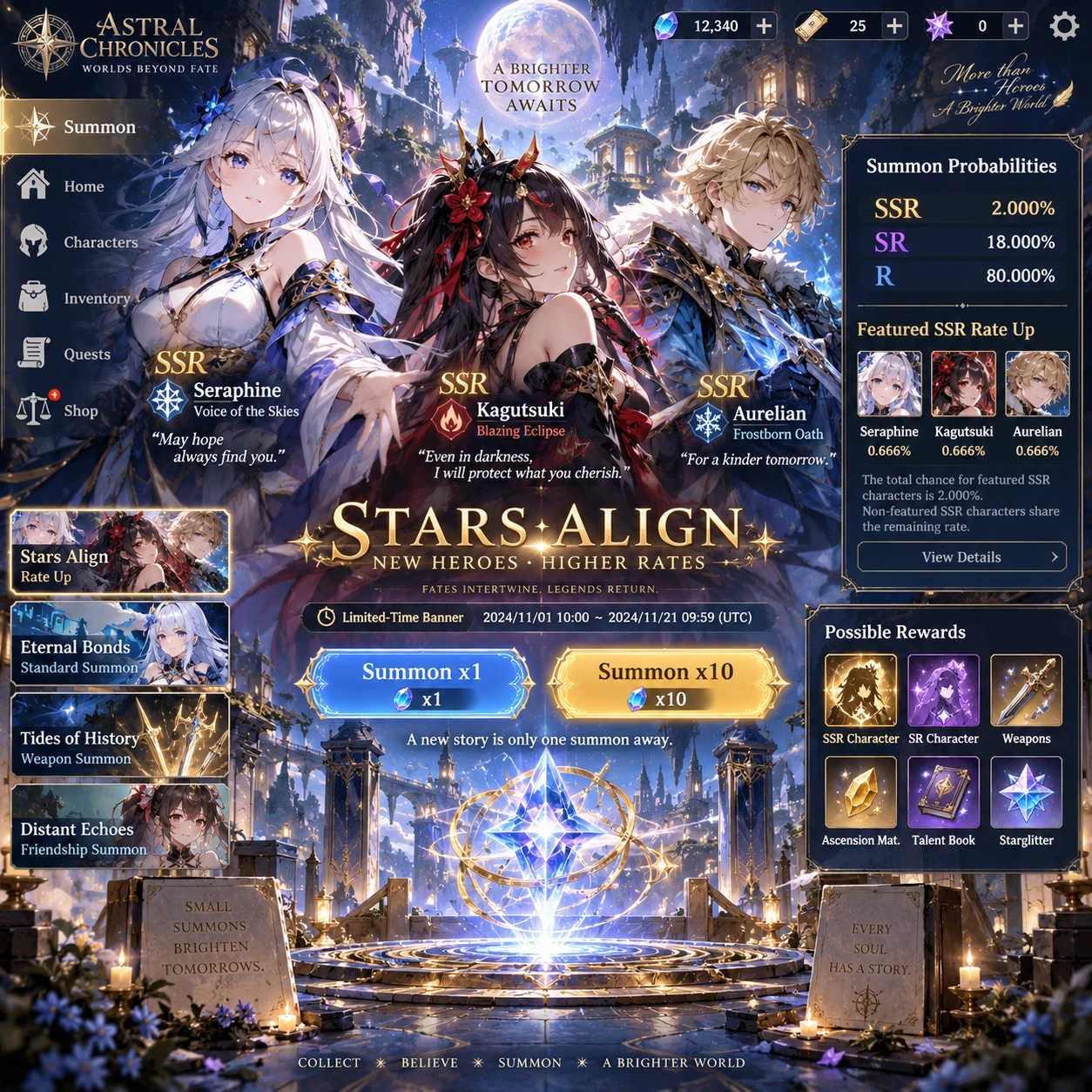
Random number generation shapes nearly every gacha pull, but a single result rarely tells the whole story. To understand what a banner offers, players need to separate published drop rates from guarantees, and individual luck from long-run probability.
Those distinctions matter in games with rate-up banners, duplicate characters, and pity systems. They also help explain why a pull can feel surprising even when the outcome follows the rules—and why two games with similar headline rates can create very different player experiences.
What RNG Means in a Gacha Game
In a gacha game, random number generation (RNG) selects rewards from a pool according to the game’s rules. Each pull produces one outcome, while the listed probabilities describe expected frequencies across many pulls rather than promises about a short session.
A simplified system assigns each reward a probability, then uses an RNG process to select an outcome. The actual implementation can vary by game, platform, and banner. Players usually see the published rates and rules, not the underlying code or every implementation detail.
The key distinction is between probability and variance. A stated chance describes how likely an outcome is on a given eligible pull. Variance describes how much observed results can differ from the average, especially across a small number of pulls.
For example, if a reward has a 1% chance on each independent pull, that does not mean one reward will arrive exactly every 100 pulls. Several may appear close together, or none may appear in a long stretch. The rate describes the chance per pull, not a schedule.
Some games also change the odds as a player approaches a threshold, or guarantee a reward after a specified number of attempts. In those cases, pulls are not all governed by one unchanged probability. Read the game’s banner rules before treating a headline rate as the full model.
Rates, Banners, and Featured Rewards
Published drop rates state the chance of receiving rewards from a banner, while rate-up rules affect the odds of selected featured items. A featured character may be more likely than an off-banner item, but “rate-up” alone does not mean “guaranteed.”
Check what the rate applies to. A banner may list the chance of receiving any top-rarity reward separately from the chance that the reward is the featured character. If several characters share a pool, the overall rarity rate does not tell you the odds for one specific character.
Banner rules can also distinguish between a featured reward and an off-banner result. In one design, a top-rarity pull may select from both groups. A separate guarantee might ensure that a later top-rarity result is featured after an off-banner outcome. The exact sequence and eligibility conditions differ, so the game’s own details are essential.
- Overall drop rate: the chance of obtaining an item of a stated rarity.
- Featured rate: the chance that an eligible reward is one of the banner’s promoted items.
- Rate-up: a higher chance for selected rewards, subject to the banner’s stated rules.
- Pool composition: the characters or items that can be drawn, including possible off-banner rewards.
One practical check is to follow the path from a single pull to the named prize: What is the chance of reaching the relevant rarity, and what happens after that? This prevents a common misunderstanding in which the advertised rarity rate is mistaken for the chance of a specific character.
Pity Systems and Guarantees
A pity system reduces or limits uncertainty by awarding a reward after a stated number of pulls, or by increasing the odds as pulls accumulate. A guarantee is only useful to interpret when you know its threshold, conditions, and reset rules.
Some systems use a fixed ceiling: if the player has not received a qualifying reward by a particular point, the next eligible pull provides one. Others increase the chance gradually after a threshold, sometimes called a soft pity system. These approaches can produce different expected outcomes even when their displayed base rates look alike.
Check four details before counting on pity:
- What counts: Does every pull contribute, or only pulls on a particular banner type?
- What resets it: Does receiving a top-rarity item restart the counter?
- Whether progress carries over: Does the counter transfer to another banner of the same kind?
- What the guarantee awards: Is it any high-rarity reward, a featured reward, or a choice among items?
A guarantee can cap the number of attempts needed for a defined outcome, but it does not automatically make each earlier pull more likely to succeed. Nor can players assume pity progress carries over between banners: games may treat limited, standard, weapon, or event banners separately. Choosing to rely on a guarantee can make results more predictable, while requiring enough eligible pulls to reach its conditions.
Why Pull Results Feel Unpredictable
Pull results feel unpredictable because short streaks can differ sharply from a probability’s long-run average. If pulls are independent, a previous miss does not by itself make the next pull more likely to succeed.
People naturally look for patterns in sequences. After several misses, a player may feel a rare reward is “due.” Under an unchanged independent rate, however, the next pull has the same chance as any earlier pull. The exception is a system that explicitly changes odds or tracks progress through pity.
Consider flipping a fair coin several times. A run of heads can look unusual, yet it does not make tails more likely on the next flip. Gacha systems are usually more complex than coin flips, but the same reasoning applies when their rules specify independent pulls with fixed odds.
That does not mean every game uses independent, fixed-rate draws. Pity counters, escalating odds, guarantees, and other disclosed mechanics can make later outcomes depend on earlier ones. Players should look for those rules rather than infer a hidden pattern from a small set of personal results.
Keep records in context. A screenshot or community report can document an individual experience, but anecdotes cannot establish a game’s true rates or prove that RNG is manipulated. Large sample data can be informative when collected consistently, yet it still needs a clear method and should be compared with the published rules.
RNG as a Game-Design Choice
RNG is a design choice that affects how players pursue progression, collect rewards, and decide whether to spend. Its effects depend on the whole system, including duplicate rewards, conversion materials, banner timing, and guarantees.
Random rewards can create surprise and make collection feel varied. The trade-off is uneven access: two players following the same banner may get very different results. Duplicate characters or items add another layer. In some games, duplicates unlock upgrades; in others, they convert into currency or materials. Their value depends on how essential those upgrades are to progression.
Monetization design shapes the context around that randomness. Limited-time banners, premium currency, and paid pulls can put pressure on players to act before an event ends. A pity system may make a target’s maximum pull requirement clearer, but the cost of reaching that threshold still matters. The game may also offer free currency, event rewards, or other routes, so monetary cost cannot be inferred from the pity count alone.
For designers, randomness can support long-term engagement, but it can also undermine trust if rates and conditions are difficult to find or explain. For players, the useful question is not whether RNG is inherently fair or unfair. It is whether the rules are transparent, whether a reward is attainable within a known limit, and whether duplicates and spending pressure suit their preferences.
How to Evaluate a Gacha System
Evaluate a gacha system by checking its published rates, banner rules, pity carryover, and the practical cost or value of its guarantees. This four-part review turns a vague sense of risk into a clearer picture of what a pull can and cannot promise.
- Read the full rate table. Separate the chance of a rarity from the chance of the specific character or item you want. Confirm which rewards are in the pool.
- Trace the banner sequence. Find out what happens when a featured reward is missed and whether a later qualifying pull has a guarantee.
- Verify pity behavior. Check the threshold, any escalating odds, what resets the counter, and whether progress carries over to future banners.
- Assess the guarantee’s value. Consider how many eligible pulls it requires, what those pulls cost in the game’s currency, and whether duplicates or alternative rewards have value to you.
Also ask whether the banner is time-limited and whether its rules differ from other banner types. A counter that carries over between character banners might not apply to a weapon banner. When details are unclear, treat the guarantee as unknown until the game’s official explanation confirms it.
This framework avoids two common errors: treating a rate-up as a promise, and assuming a bad streak must be corrected by the next pull. It cannot predict a particular outcome. It can show which outcomes are possible, what the game guarantees, and where uncertainty remains.
Frequently Asked Questions
Does a bad streak make a better pull more likely?
Not under fixed, independent pull odds. A bad streak changes the results you have already seen, not the next pull’s probability. It can matter if the game’s pity or escalating-rate rules explicitly use previous pulls.
How does a pity system change the odds?
A pity system may raise the chance of a reward after a threshold or guarantee one by a stated limit. The exact effect depends on the game, so check whether it changes per-pull odds, sets a maximum, or both.
Are rate-up rewards guaranteed?
No. Rate-up means a featured reward has an increased chance under the banner’s rules. It becomes guaranteed only if the game states a specific guarantee and explains when it applies.
What should players check before pulling?
Review the rate table, eligible reward pool, featured-item rules, pity threshold, reset and carryover conditions, and the cost of reaching any guarantee. These details matter more than a single anecdote about lucky or unlucky pulls.