Top 5 Monetization Strategies for Casual Games That Respect Your Players
Why Monetization Strategy Matters More in Casual Games
Casual games live or die by friction. The audience playing a tile-matching puzzle or an arcade runner during a lunch break has a fundamentally different tolerance for frustration than someone who has invested 200 hours in an RPG. One bad paywall experience and they're gone — probably forever, and possibly with a one-star review on their way out.
This makes monetization design a higher-stakes decision in casual arcade games than almost anywhere else in the industry. The player base is enormous but shallow in commitment. That's not a criticism — it's just the nature of the genre. These players can become loyal, paying supporters, but only if the game earns it.
The good news is that ethical monetization and business profitability are not in conflict. Games that treat players fairly tend to retain them longer, generate better word-of-mouth, and build the kind of community that sustains a title for years. The strategies below reflect that reality.
What Makes a Monetization Model Predatory (And What Doesn't)
A monetization model becomes predatory when it exploits psychological vulnerabilities rather than offering genuine value. The clearest examples are gacha mechanics and loot boxes with hidden probability odds — systems where players spend real money without knowing their actual chances of receiving a desired reward.
Pay-to-win pressure is another red flag. When spending money provides a meaningful gameplay advantage — faster progress, stronger abilities, exclusive content that affects outcomes — the game stops being a game and starts being a transaction. Players who don't spend feel punished, not just less rewarded.
Artificial scarcity is subtler but equally damaging. Countdown timers on offers that reset every 24 hours, "limited" items that reappear regularly, and pop-up purchase prompts triggered by failure moments are all designed to override rational decision-making. They work in the short term. They destroy player trust in the long term.
The contrast is straightforward: ethical monetization offers something players genuinely want, at a price they can evaluate clearly, without psychological pressure to buy right now. Every strategy below meets that standard.
Strategy #1 — Cosmetic Microtransactions That Add Delight, Not Advantage
Cosmetic microtransactions — skins, character themes, visual effects, board designs — generate revenue without touching game balance or probability outcomes. A player who buys a neon color theme for their arcade game pieces plays the exact same game as someone using the default skin. The purchase is purely expressive.
This matters mechanically because it keeps the game's core probability systems honest. If randomness governs how tiles fall or how obstacles appear, that randomness is identical for every player regardless of spending. There's no pay-to-win distortion to worry about, and no need for probability disclosure on cosmetic purchases because nothing is being randomized — the player sees exactly what they're buying.
For casual arcade games specifically, cosmetic options work best when they feel like genuine personalization rather than a content wall. Offer a compelling default experience, then let players express their style. Character skins tied to themes the player already loves — seasonal designs, color palettes, animated effects — convert at higher rates than generic upgrades because they feel personal.
The trade-off worth acknowledging: cosmetic monetization requires ongoing content creation. A cosmetic shop that hasn't been updated in six months signals an abandoned game. Budget for regular additions if this is your primary revenue channel.
Strategy #2 — Rewarded Ads With Genuine Player Control
Rewarded ads are opt-in video advertisements that grant in-game bonuses — an extra life, a soft currency bonus, a power-up — in exchange for the player's time and attention. The critical word is opt-in. When players choose when to watch an ad, the dynamic shifts from interruption to exchange.
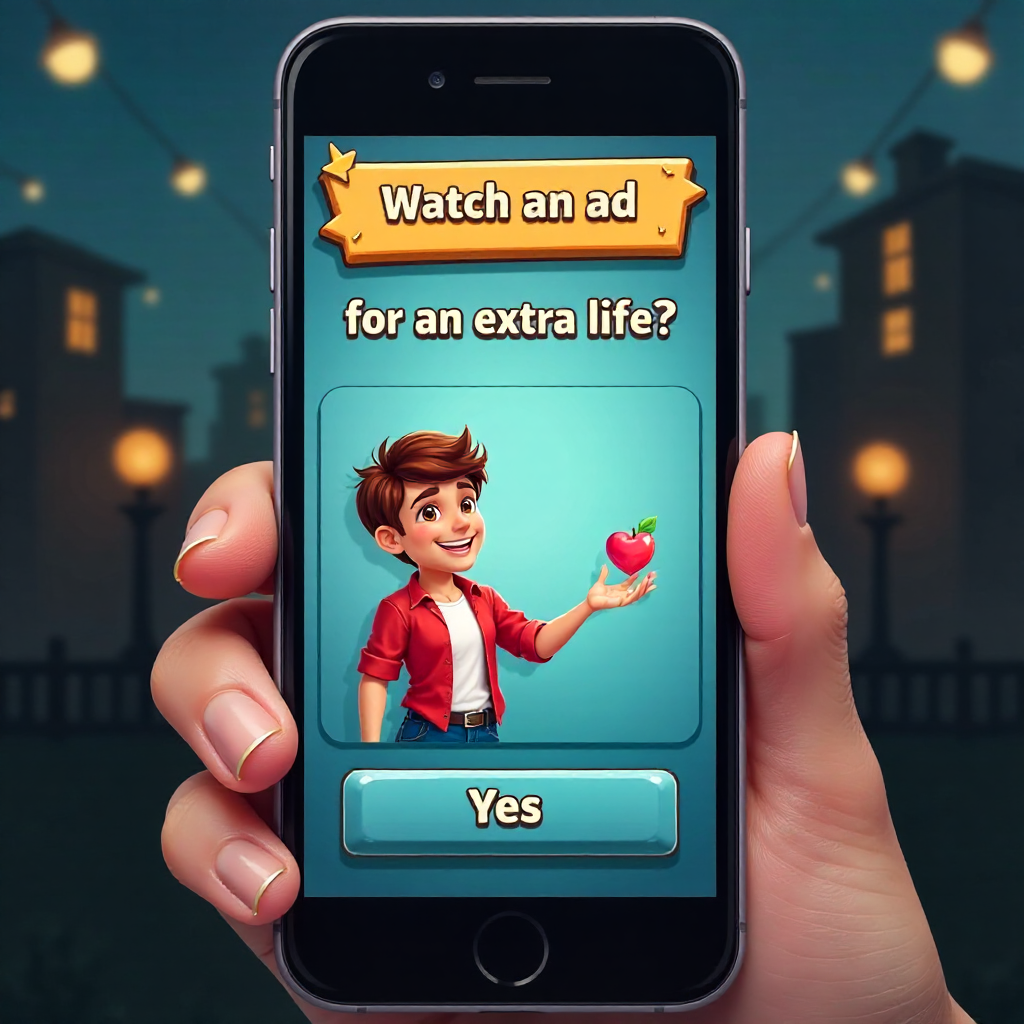
Forced interstitial ads — the kind that appear mid-game without warning — are one of the fastest ways to erode player retention in casual games. They break flow, feel disrespectful, and train players to associate your game with annoyance. Rewarded ads do the opposite. Players who choose to watch an ad have already decided the reward is worth their 30 seconds. That's a fundamentally different psychological transaction.
From a mechanics standpoint, calibrate the reward carefully. An extra life offered after a difficult failure moment is genuinely useful and feels generous. A reward so small that it's not worth the interruption will be ignored. A reward so large that it trivializes the challenge undermines game balance. Test where the value-to-effort ratio feels right for your specific game loop.
Player retention data consistently shows that games with well-implemented rewarded ads outperform games with forced ads on session length and return visit rates. The autonomy itself is the feature.
Strategy #3 — A Fair Season Pass Built Around Gameplay Progression
A well-designed battle pass or season pass rewards players for doing what they'd already be doing — playing the game. The structure is simple: players progress through tiers by completing gameplay objectives, unlocking rewards along the way. A paid tier offers additional or premium rewards on the same track.
What separates a fair season pass from a predatory one comes down to two design decisions. First, the free tier must be genuinely rewarding. If free players feel like they're being shown what they're missing rather than given real value, the pass becomes a FOMO machine rather than a progression system. Second, the paid tier should be purchasable at any point in the season and still completable — players who discover the game mid-season shouldn't feel locked out.
For casual arcade games, season pass themes work best when they connect to the game's existing mechanics. A speed-runner arcade game might offer a season themed around velocity and precision, with rewards tied to performance milestones. This keeps the pass feeling native to the experience rather than bolted on.
Avoid the common mistake of making pass completion require daily logins or grinding sessions that exceed what a casual player can reasonably manage. A casual game audience has limited time by definition. Design the completion curve for someone who plays 15-20 minutes a day, not someone who plays for hours.
Strategy #4 — The "Remove Ads" Premium Unlock
The remove-ads premium purchase is one of the most honest monetization mechanics in mobile gaming. The player has experienced the free version, decided they enjoy the game enough to commit, and can make a single payment to improve their experience permanently. No subscriptions, no recurring charges, no ambiguity.
This model works because it converts players at the moment of genuine satisfaction. Someone who has played your casual arcade game long enough to find the ads annoying is, by definition, a player who likes your game. The purchase offer meets them at exactly the right moment in their relationship with the product.
Price it honestly. In most casual game markets, a one-time remove-ads unlock priced between $1.99 and $4.99 converts well because it clears a psychological threshold — it costs less than a coffee, and the player knows exactly what they're getting. Higher prices are harder to justify for a single feature unlock unless bundled with additional content.
The strategic value extends beyond the transaction itself. Players who have paid for an experience, even a small amount, are more likely to leave positive reviews, recommend the game to others, and return after periods of inactivity. The premium unlock creates a sense of ownership that free players don't have.
Strategy #5 — Transparent Soft Currency Systems With Clear Value Exchange
Soft currency systems — in-game coins, gems, or tokens earned through gameplay — become ethical or exploitative based entirely on how transparent they are. When players understand exactly what their currency is worth and what they're spending it on, the system is fair. When currency layers are designed to obscure real-money costs, they're not.
The distinction between soft currency (earned through play) and hard currency (purchased with real money) matters here. Many casual games use both, which is fine — the problem arises when hard currency is priced in bundles that don't align cleanly with purchase costs, making it genuinely difficult for players to calculate what they're spending. A player who bought 550 gems for $4.99 and is looking at a 300-gem item shouldn't need a calculator to understand the real-money cost.
Where randomness enters the picture — a spin wheel, a mystery box, a randomized daily reward — probability disclosure becomes a design responsibility, not just a regulatory one. Players deserve to know their odds before they spend. This is especially true if any random reward can be purchased with hard currency. Displaying drop rates clearly isn't just ethical; it's increasingly expected by players who have grown skeptical of opaque systems after years of gacha mechanics in mobile games.
Design the soft currency economy so that a player who never spends real money can still earn meaningful rewards through consistent play. The currency should feel like a genuine in-game resource, not a gateway designed to highlight what's out of reach. That balance is what keeps the economy feeling like a game feature rather than a monetization trap.
Frequently Asked Questions
Can casual games be profitable without loot boxes or pay-to-win mechanics?
Yes — and many of the most durable casual games on the market prove it. Titles built on rewarded ads, cosmetic shops, and one-time unlocks generate consistent revenue without the player backlash that predatory mechanics eventually produce. The profitability ceiling may be lower in the short term, but the long-term retention advantage typically compensates.
What is the difference between soft currency and hard currency in mobile games?
Soft currency is earned through gameplay — completing levels, daily bonuses, achievements. Hard currency is purchased with real money. Most games use both, with soft currency covering common purchases and hard currency reserved for premium items or faster progression. The ethical line is keeping the exchange rate between the two clearly communicated to players.
How do rewarded ads affect player experience compared to forced ads?
Rewarded ads consistently produce better player experience metrics than forced interstitial ads. Because players opt in, they associate the ad with a positive outcome (a bonus) rather than an interruption. Session length and return visit rates tend to be higher in games that use rewarded ads exclusively compared to those that mix in forced placements.
Should casual games disclose probability odds for random rewards?
If any random reward system can be accessed using real money — directly or through purchased hard currency — disclosing the odds is both an ethical obligation and, in many jurisdictions, a legal one. Even where it isn't legally required, probability transparency builds player trust and reduces the frustration that drives uninstalls. For a deeper look at how probability disclosure is evolving in game regulation, this overview of loot box regulation covers the current landscape across different markets.
Which monetization model works best for a new casual arcade game with a small player base?
For a small or early-stage player base, rewarded ads combined with a remove-ads premium unlock is the most practical starting point. Both require minimal content infrastructure to implement, both are immediately understandable to players, and neither requires the ongoing content pipeline that a season pass or large cosmetic shop demands. Build the audience first, then layer in more complex systems as retention data gives you something to optimize against.