How to Balance Skill and Luck in Your Game Design
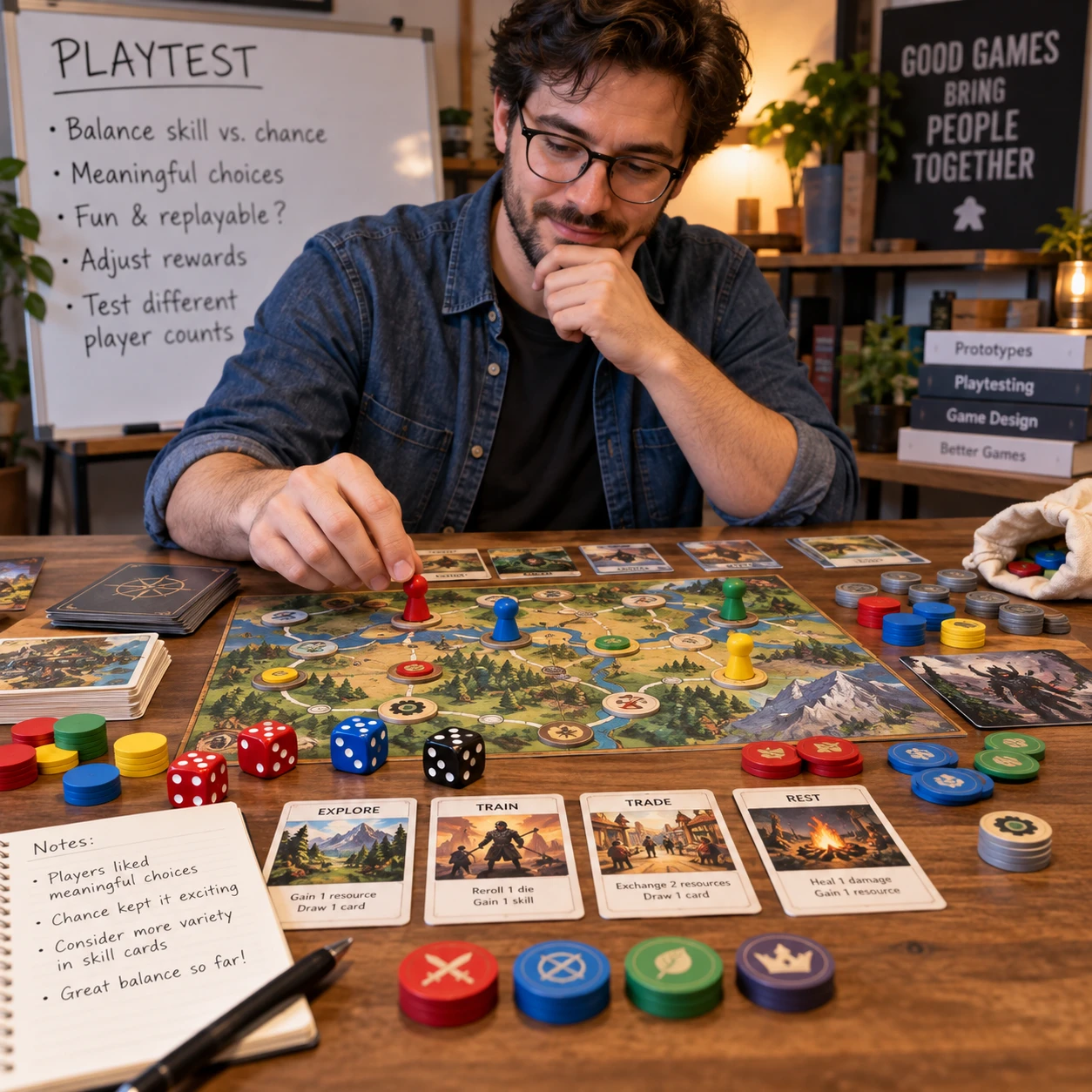
A well-balanced game lets players make decisions that matter while leaving enough uncertainty to keep each session alive. Skill gives players room to learn, plan, and express mastery; luck creates surprises and fresh problems to solve. The goal is not to find one perfect ratio, but to make randomness serve the experience you want.
When skill and luck work together, players can accept an unlucky result because their choices still mattered. When they clash, a random outcome can make careful play feel pointless. Use the following design principles to build uncertainty that supports fairness, player agency, and replayability.
Define the Role of Skill and Luck
Skill rewards decisions, knowledge, timing, or execution; luck introduces outcomes players cannot fully control. Decide what each should contribute to your game before choosing mechanics.
Start by describing the intended player experience in plain terms. Should a strong player usually win over a series of matches? Should new players have a chance to surprise a veteran in a short session? Should players feel clever for adapting to a bad draw? These goals point toward different forms of game balance.
Skill expression can come from tactical positioning, resource management, reading opponents, building a strategy, or executing precise actions. Randomness can come from dice, shuffled cards, variable setup, hidden information, or a random number generator (RNG). Each source affects agency differently. A shuffled deck may create a changing set of options, while a die roll may decide whether an action succeeds.
Separate uncertainty from lack of control. Players may enjoy not knowing which card will appear, yet still want choices about how to respond. That distinction is useful: uncertainty creates tension, while perceived helplessness creates frustration. If a mechanic produces a surprising result, ask whether players had any meaningful decision before or after it.
Match the Balance to Your Game and Audience
The right mix of skill and luck depends on the game’s genre, session length, and audience. A quick party game can use more swingy outcomes than a long strategy game where players invest time in planning.
Think in terms of the cost of a bad result. In a five-minute round, a surprising reversal may be entertaining. In a two-hour campaign, losing progress to one random event can feel punishing. Competitive players may expect consistent skill expression, while casual groups may value easy entry and unpredictable social moments. Neither preference is universal.
Use three questions to set a starting point:
- What should players feel? Tension, mastery, surprise, or a mix?
- How long does a result matter? A single turn, one match, or many sessions?
- Who is the game for? Newcomers, experienced strategists, or a mixed group?
Then choose randomness with those answers in mind. A beginner-friendly game might use visible dice outcomes and simple rerolls. A deep strategy game might use a predictable resource curve with a small number of uncertain events. Choosing more randomness for accessibility can make outcomes less predictable; choosing greater control for competitive depth can increase the learning curve and widen the gap between experienced and new players.
Use Randomness to Create Meaningful Choices
Randomness creates meaningful choices when players can make informed decisions before or after an uncertain result. It should change the problem they solve, rather than simply cancel the value of their decisions.
One useful test is to ask: “What can the player decide because this uncertainty exists?” If the answer is nothing, the mechanic may feel arbitrary. A card drawn from a small set, for example, might present different costs and benefits that players can plan around. A hidden event can create a choice between taking a safe route or pursuing a higher reward with greater risk.
Make uncertainty legible where possible. Players do not need to know the exact next result, but they benefit from understanding the range of outcomes and the stakes. If a special ability can produce a critical success or a serious setback, explain the odds or make the possible results visible. Clear information lets players make decisions instead of guessing at the rules.
Consider the timing of randomness, too. A random event before a player chooses can shape a strategy; a random event after the choice can test whether that strategy adapts. Both can work. Repeatedly placing decisive randomness after an irreversible decision, however, may make planning feel hollow. The design question is not whether a roll is random, but whether the surrounding decisions give it context.
Give Players Tools to Manage Risk
Players can accept uncertain outcomes more readily when they have limited ways to manage risk. Rerolls, resource spending, protective abilities, and tactical responses all preserve agency, though each can reduce surprise if used too freely.
Useful tools include:
- Rerolls: Let a player retry a result, often by spending a scarce token or accepting a drawback.
- Resource spending: Allow players to turn stored resources into a better chance of success or a smaller loss.
- Multiple options: Let a player choose between uncertain actions, such as a safer move with modest reward and a risky move with a higher payoff.
- Preparation: Offer equipment, positioning, or abilities that improve resilience before a random event occurs.
- Post-result responses: Give players a way to block, redirect, or soften an outcome after seeing it.
These mechanics create a risk-and-reward decision: how much is a better outcome worth, and what future opportunity will the player give up to pursue it? Keep the cost visible. If a reroll is free and unlimited, it can erase the tension randomness was meant to create. If the cost is too steep, players may ignore the tool and still feel powerless.
A practical design rule is to make risk management meaningful but finite. Players should be able to influence a bad outcome without guaranteeing they can always escape it.
Keep Luck from Overriding Skill
To keep luck from overriding skill, limit the impact of extreme outcomes, prevent early advantages from compounding too quickly, and leave players with ways to recover. A lucky moment can change a match without deciding it outright.
First, look for runaway effects. If winning a round grants resources that make the next round easier, an early lucky result can become a lasting lead. You can soften that pattern with catch-up options, diminishing returns, or objectives that reward different players for different strengths. These tools can make the game feel fairer, but excessive catch-up support may make early success feel meaningless.
Second, examine streaks. A series of bad rolls may be statistically possible yet unpleasant in play. Consider whether players can use a limited safety valve, whether failure still advances the game, or whether the consequence should be smaller after repeated setbacks. Avoid secretly changing RNG results to rescue a player unless the game clearly communicates that system; hidden correction can damage trust.
Finally, check how much one result can decide. If one random event ends a long match, provide warning, counterplay, or a way to recover. If the intended experience is fast and chaotic, that same event may be a feature. The right answer depends on the promise your game makes to its audience.
Playtest, Observe, and Tune
Playtesting reveals whether your skill-to-luck balance works in practice. Track outcomes, but also observe whether players understand their choices, feel responsible for results, and want to play again.
Test with different experience levels and play styles. A group of expert designers may spot efficient strategies quickly but miss how confusing a random effect feels to a first-time player. Run tests with new players, regular players, and people who approach the game differently. Keep the rules and setup consistent enough to compare sessions.
Record more than wins and losses. Useful observations include:
- How often a random result changes a player’s plan.
- Whether players can explain why a decision was risky.
- How often players use rerolls or other risk-management tools.
- Whether a player who falls behind still has viable choices.
- Which outcomes prompt excitement, discussion, or disengagement.
When possible, compare the game across repeated sessions. One match can be dominated by an unusual sequence; patterns across many plays offer better evidence. Change one major variable at a time, such as reroll cost or the size of a random reward, so you can connect cause and effect. Then test edge cases: long losing streaks, unusually lucky starts, and strategies that avoid risk entirely.
Ask players specific questions rather than only “Was it fair?” Try: “Which decision had the biggest effect on the result?” and “When did you feel you could no longer influence what happened?” Their answers help distinguish a satisfying surprise from a frustrating loss of agency.
Frequently Asked Questions
There is no universal formula for balancing skill and luck. The answers depend on what your game promises, how long outcomes matter, and how much control players need to enjoy uncertainty.
How much randomness should a game have?
Use enough randomness to create variation and interesting decisions, but not so much that player choices stop affecting outcomes. Test the amount against your audience and session length rather than aiming for a fixed ratio.
How can players influence random outcomes?
Give players tools such as rerolls, resource spending, alternative actions, protective abilities, or responses after a result. Make each tool limited or costly enough that using it remains a decision.
How do you make luck feel fair?
Make the possible outcomes and stakes understandable, give players relevant choices, and avoid letting one surprise erase a long series of decisions without warning or counterplay.
Can a highly random game still reward skill?
Yes. Skill can lie in managing resources, choosing when to take risks, adapting to new information, or recognizing favorable odds. Random outcomes can vary from session to session while skilled decisions still improve a player’s chances over time.